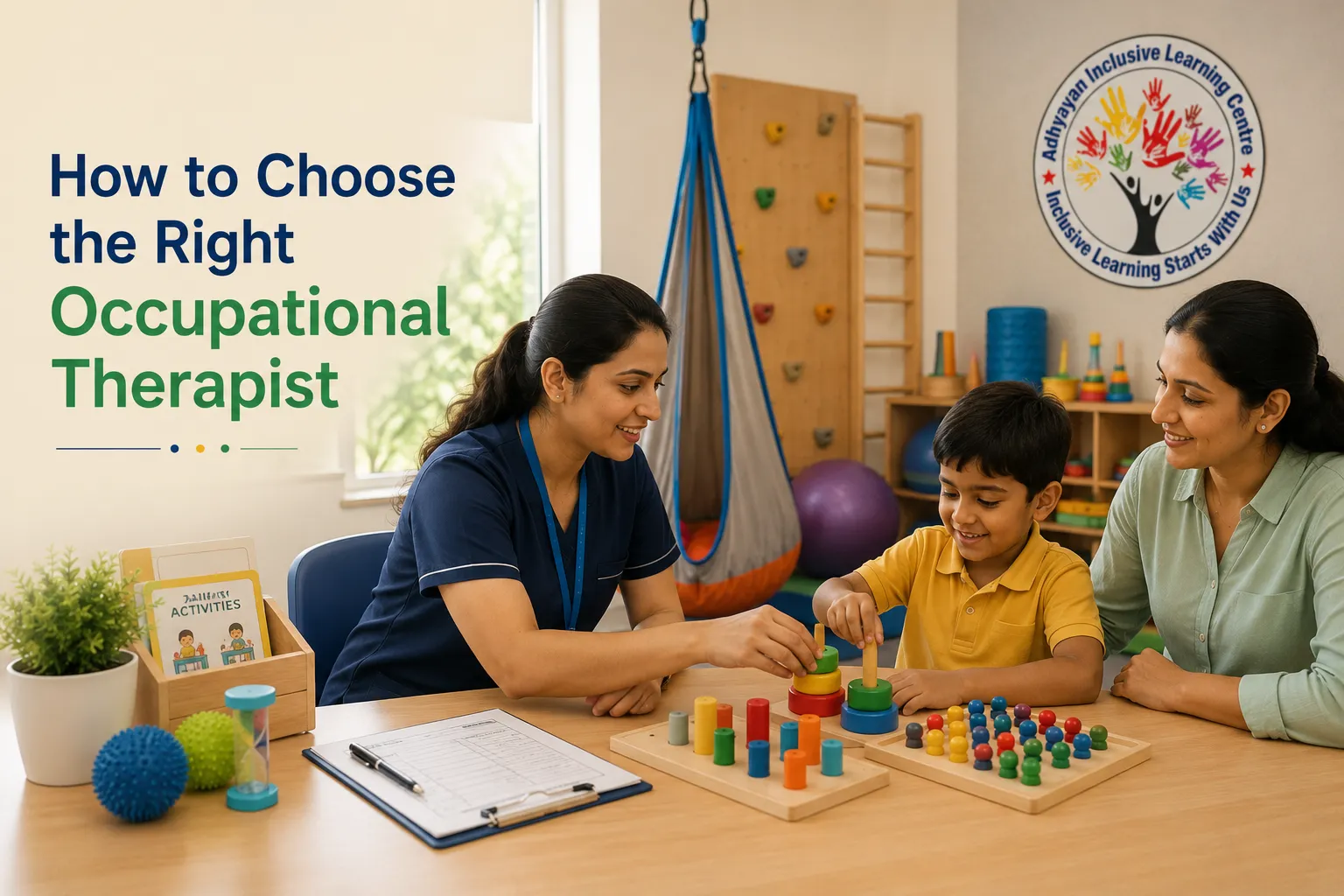
How to Choose the Right Occupational Therapist
You've finally accepted that your child needs occupational therapy. Maybe a paediatrician mentioned it, maybe a teacher flagged it, or maybe you noticed it yourself — the trouble with handwriting, the meltdown every time socks feel "wrong," the way stairs still feel like a small mountain at age six. Whatever brought you here, you've made peace with the idea. Now comes the part nobody really prepares you for: actually finding the right therapist.
And this is where most parents hit a wall. A quick search throws up a dozen names, half a dozen clinics, and an overwhelming number of credentials you don't fully understand. Everyone's website says "experienced," "compassionate," and "child-centered." So how do you actually tell who's right for your child?
I've sat across the table from enough parents going through this exact confusion to know it's rarely about finding "the best" therapist in some abstract sense. It's about finding the right fit — someone whose expertise matches your child's specific needs, whose approach your child responds to, and who you, as a parent, can actually trust and communicate with over months (sometimes years) of therapy.
Here's a practical, no-fluff way to think about it.
Start With Qualifications — But Don't Stop There
This sounds obvious, but it's worth saying clearly: check that the therapist is actually a licensed occupational therapist, with a recognized degree and valid registration with the relevant professional body in your country. This isn't a formality — it's your baseline filter.
But qualifications alone don't tell you much about fit. Two therapists with identical degrees can have completely different areas of strength. Some OTs specialize heavily in sensory processing disorders. Others are stronger with fine motor and handwriting work. Some have deep experience with autism spectrum conditions, while others come from a more general paediatric background. Ask directly: "What age groups and conditions do you work with most often?" A confident, specific answer is a good sign. A vague one isn't necessarily a red flag, but it should prompt more questions.
Look for Experience With Your Child's Specific Profile
This is the part parents often skip, and it matters more than almost anything else on this list.
A therapist who's spent years working with sensory processing challenges in autistic children brings a very different toolkit than one whose experience is mostly post-injury rehabilitation in adults, even if both are technically "occupational therapists." Ask about their caseload. Ask if they've worked with children who have a similar profile to yours — similar diagnosis, similar age, similar specific struggles.
Don't be shy about asking for this detail upfront, either in a phone call or during an initial consultation. A good therapist won't be offended by the question; they'll usually welcome it, because it means you're taking the process seriously.
Pay Attention to the First Session
Credentials get you in the door. What happens in the room is what actually matters.
Watch how the therapist interacts with your child in that very first session. Do they get down to your child's level, literally and figuratively? Do they observe before jumping in with instructions? Do they seem to notice small things — how your child holds a crayon, how they react to a loud noise, how long their attention span really is — rather than following a rigid, one-size-fits-all script?
Also watch how your child responds. Some kids warm up slowly to anyone new, so don't judge purely on day one comfort levels. But do notice whether the therapist adjusts their tone, pace, and activities based on your child's reactions, or whether they push forward regardless. Flexibility in the room is often a better predictor of long-term progress than any certificate on the wall.
Ask About Their Approach to Parent Involvement
Therapy that happens only within four walls, one hour a week, rarely produces the results parents hope for. The therapists who get real results are usually the ones who treat parents as partners, not bystanders.
Ask directly: "How do you involve parents in the process? Will I get home activities? How often do we discuss progress?" A good occupational therapist should be able to explain, clearly, how they'll keep you looped in — not just with generic updates, but with specific, actionable guidance you can use at home. If a therapist seems reluctant to explain their methods to you as a parent, that's worth noting.
Consider the Setting, Not Just the Person
Individual skill matters enormously, but so does the environment the therapy happens in. A well-equipped sensory gym with swings, climbing structures, and varied textured tools allows an OT to design far richer sessions than a bare room with a table and a few worksheets.
Equally important is whether the centre takes a collaborative approach across disciplines. Many children who need occupational therapy also benefit from speech therapy, special education, or behavioural support running alongside it. A centre where these professionals actually talk to each other — sharing notes, adjusting goals together — tends to produce more coherent progress than therapies happening in completely separate, disconnected silos. If you're evaluating a centre's occupational therapy programme, it's worth asking directly whether their OT team coordinates with other specialists on-site, because that coordination often makes the real difference in outcomes.
Don't Underestimate Logistics
This one feels unglamorous, but it genuinely affects consistency, and consistency is everything in therapy. Consider:
- How far is the clinic from your home or your child's school?
- Does the schedule realistically fit your routine, week after week, without becoming a constant source of stress?
- Is the cost sustainable for the duration you'll likely need — usually months, sometimes longer?
- Does the centre offer any flexibility if a session needs rescheduling, given how unpredictable life with a young child can be?
A brilliant therapist thirty minutes further than a good one might sound like an easy choice on paper. But if that extra distance means you end up missing one session a month due to traffic, school pickup clashes, or sheer exhaustion, the "better" therapist stops being better in practice. Sustainable logistics often beat marginal expertise differences.
Trust Your Own Observations Over Time
Here's something I tell every parent: give it a fair trial period — usually somewhere between four to eight sessions — before deciding whether it's working. Progress in occupational therapy is rarely dramatic or instant; it shows up gradually, in small wins. A little more patience during a difficult sensory experience. Slightly better pencil grip. One less meltdown during a transition that used to be a daily battle.
But also trust yourself if something feels consistently off after that fair trial — if your child dreads sessions with no signs of easing in, if the therapist seems disengaged, or if you're not getting clear communication about progress or goals. It's okay to switch. It's not a failure on your part, and it's not disloyalty to end something that isn't serving your child well. The goal was never to find "a" therapist; it was always to find the right one for your child.
A Few Questions Worth Asking Before You Commit
To make this easier, here's a short list you can literally bring to your first consultation:
- What's your experience with children who have a similar profile to my child?
- What does a typical session look like, and how do goals get set?
- How will progress be measured and communicated to me?
- Do you coordinate with other therapists or educators involved in my child's care?
- What's a realistic timeline before we should expect to see noticeable change?
Any therapist worth choosing should be able to answer these clearly, without dodging or over-promising.
Conclusion
Choosing the right occupational therapist isn't about finding the most impressive resume in your city. It's about finding someone whose specific expertise matches your child's needs, who genuinely involves you in the process, who works within a setting that supports real progress, and whose logistics fit sustainably into your family's life. Take your time with this decision — it's one of the few areas where a little extra diligence upfront saves months of frustration later.