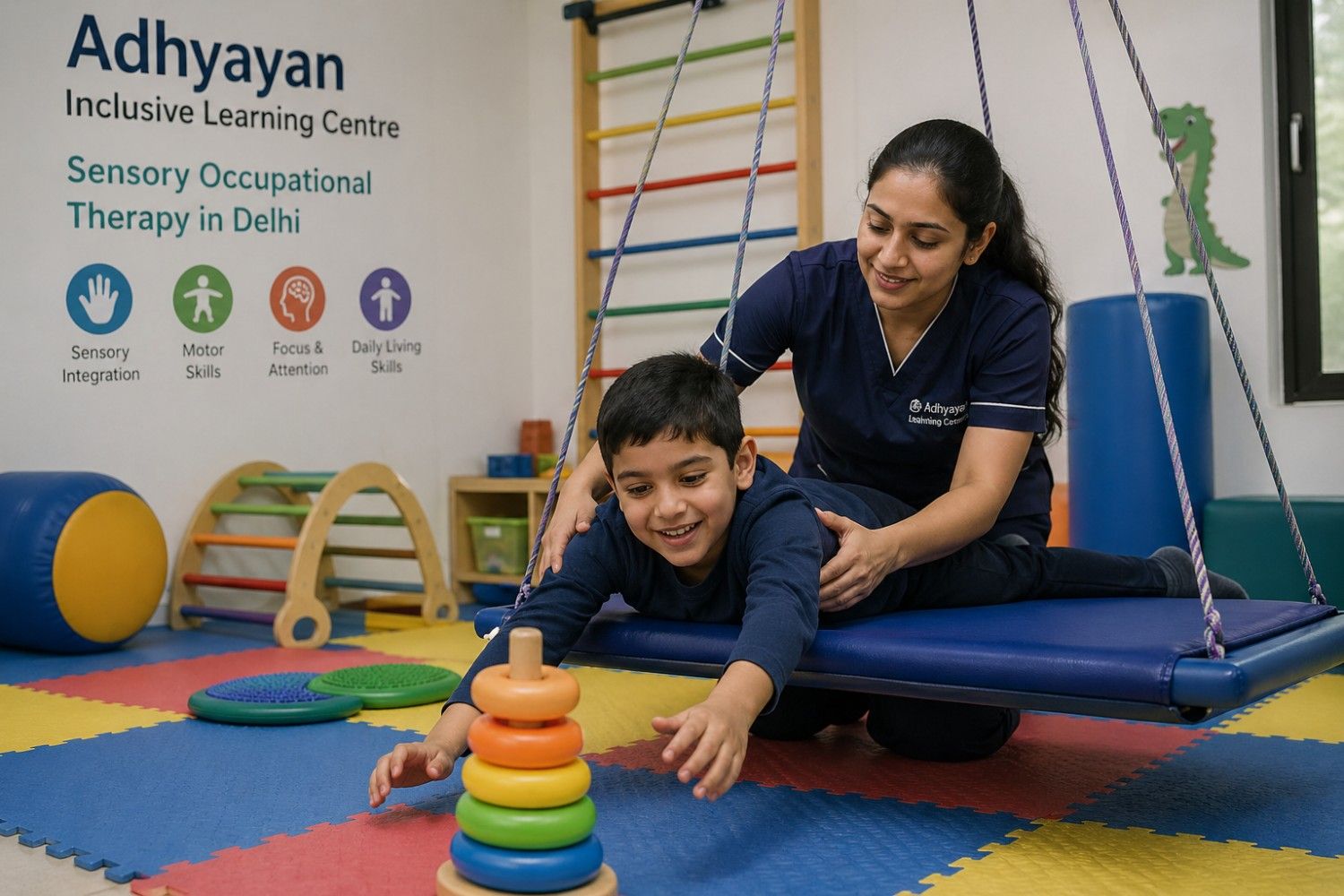
Some children flinch at the hum of a hand dryer, refuse socks with seams, or spin and crash into furniture all afternoon. These are often signs that a child's nervous system handles sensory information differently. Sensory occupational therapy in Delhi at Adhyayan Inclusive Learning Centre (AILC) is built for these children. Our occupational therapists use sensory integration therapy, a play-based approach, to help children respond to sound, touch, movement and light with more comfort and control.
This page explains how child sensory integration works, the signs to look for, what a session involves, and what research says. It also covers how to find sensory integration therapy near you in South Delhi.
What Is Sensory Integration in Children?
Sensory integration is the way the brain organises information from the senses so that a child can respond usefully. The senses include touch, sound, sight, taste, smell, movement and body position. When this works smoothly, a child barely notices it. They wear a school uniform comfortably, tune out classroom noise and judge how hard to press a pencil.
When it works differently, everyday sensations can feel too loud, too rough or too faint. Behaviour often shows this before a child can explain it in words.
Two senses are easy to overlook. The vestibular sense tracks movement and balance, and proprioception tells the body where it is in space and how much force to use. A child who crashes, spins or climbs constantly may be looking for input these senses are not giving them.
Signs Your Child May Need Sensory Occupational Therapy
Signs usually fall into three groups. One sign alone is rarely a concern, but several together, or signs that disrupt school and home life, justify an assessment.
Over-responsive to sensation
- Covers ears or becomes distressed around everyday noise
- Refuses certain clothes, food textures or messy play
- Struggles with haircuts, nail cutting or clothing tags
- Becomes anxious or overwhelmed in crowds
Seeking more sensation
- Moves constantly, spins, jumps or crashes into things
- Chews on non-food objects
- Seeks tight hugs or deep pressure
- Seems unaware of pain or of being messy
Motor and daily-life difficulties
- Clumsiness or poor balance
- Difficulty with handwriting, dressing or using cutlery
- Trouble sitting through a task or staying with a routine
Sensory differences are common in children with autism, ADHD and developmental delays, but a child does not need a diagnosis to be assessed. Our guide on whether your child needs paediatric occupational therapy can help you decide on next steps.
How Sensory Integration Therapy Works at AILC
Each child's plan begins with a conversation and an assessment, not a standard programme:
- Parent interview. We ask about your child's sensory reactions, daily routines, sleep, eating and school.
- Assessment. The therapist observes your child in play and structured tasks, and may use a caregiver questionnaire to understand patterns across settings.
- Goal setting. We agree two or three priorities with you, such as tolerating a haircut, sitting through circle time, or holding a pencil comfortably.
- Therapy sessions. Activities are matched to the goals and adjusted so the challenge is one your child can meet with effort.
- Home plan and review. You receive short routines to repeat at home, and we review progress against the goals at regular intervals.
What Happens in a Session
Sessions look like play, and the play has a purpose. A swing or trampoline gives controlled movement input that can help a child settle or organise their body. Balance boards and obstacle courses build coordination and planning, and sensory bins let a child explore textures at their own pace.
Deep-pressure activities, such as pushing weighted objects, often help children who seek strong input. Fine-motor tasks like drawing and cutting are added once the child is regulated enough to focus. The therapist watches your child's responses throughout and changes the activity when needed.
What Research Says About Sensory Integration Therapy
Opinion on sensory integration therapy has been divided, so it is worth being direct. A 2025 systematic review of randomised controlled trials in the American Journal of Occupational Therapy looked at Ayres Sensory Integration, the structured form of the approach. It found strong evidence that the approach helps autistic children meet individualised goals, and moderate evidence that it does not reduce behaviours of concern such as noncompliance or irritability. The authors note that the debate continues and that more research is needed.
This is why we set specific goals with parents and track them, rather than promising general improvement. When a child's difficulties go beyond sensory processing, we combine this work with other supports.
Who Can Benefit from Sensory Occupational Therapy?
Sensory-based work is often part of the plan for children with autism, ADHD, learning disabilities, developmental delays, and sensory processing difficulties without another diagnosis. If your child has autism, our page on occupational therapy for autism explains how we use sensory work alongside play and daily routines.
Younger children benefit from early support, which gives them more time to build skills before school demands increase. See our early intervention programme for children with developmental delays.
When Sensory Work Fits Alongside Other Therapies
Sensory difficulties rarely appear alone. A child who gags on textures may also benefit from oral motor therapy, and a child with frequent meltdowns may need behaviour support as well. Because our occupational therapists work alongside speech therapists, special educators and psychologists, goals can be coordinated instead of treated in isolation. You can read more about our full occupational therapy services.
Students and parents researching OT as a career can also read our guide to the Best Occupational Therapy School in NCR for Students.
Finding Sensory Integration Therapy Near You in South Delhi
AILC is at E-17, 2nd Floor, South Extension Part 1, New Delhi 110049. The centre is open from 10 am to 7 pm and is easy to reach from nearby areas such as Lajpat Nagar, Defence Colony and Greater Kailash. To book an assessment, call +91 98100 52388 or use the contact form.