If you're reading this, chances are you've already noticed something. Maybe your child isn't babbling the way other toddlers do. Maybe words came late, or came and then seemed to disappear. Maybe your child talks plenty but struggles to hold a back-and-forth conversation, or gets frustrated when you can't understand what they're trying to say.
Whatever brought you here, you're not overreacting, and you're not alone. Communication differences are one of the earliest and most common signs of autism spectrum disorder (ASD), and they're also one of the most treatable. This is where speech therapy for autism comes in — not as a quick fix, but as a structured, evidence-based path toward a child expressing themselves, understanding others, and connecting with the world around them.
This guide breaks down what speech and language therapy for autism actually involves, how it works in real life (not just in theory), and how to know when it's time to get help.
What Is Speech Therapy for Autism, Really?
A lot of parents assume speech therapy is only about pronunciation — helping a child say their "s" sounds correctly or stop lisping. That's part of it, but for autistic children, the scope is much wider.
Speech language therapy for autism typically works on four connected areas:
- Expressive language – using words, phrases, or alternative methods to communicate wants, needs, and ideas
- Receptive language – understanding what others are saying, including instructions and questions
- Pragmatic (social) language – eye contact, turn-taking, reading tone and body language, staying on topic in a conversation
- Speech clarity and articulation – forming sounds and words that others can understand
Autism affects communication differently in every child. Some children are non-verbal and need help building a foundation from scratch. Others speak fluently but struggle to read social cues or hold a two-way conversation. Some repeat phrases they've heard elsewhere (a pattern called echolalia) without necessarily attaching new meaning to them. A good speech-language pathologist (SLP) doesn't apply one method to every child — therapy is built around where that specific child is starting from.
Why Speech Therapy Matters So Much in Autism
Communication difficulty isn't just an academic or developmental concern — it shapes a child's entire day. A child who can't tell you their stomach hurts, or that a loud noise is overwhelming them, often expresses that distress through behavior instead: meltdowns, withdrawal, or repetitive movements. Parents frequently discover that as communication improves, so-called "behavior problems" quietly start to ease, simply because the child finally has another way to be understood.
There's also the longer-term picture. Communication skills are tied closely to how a child learns to read, make friends, and eventually function independently as an adult. Starting therapy early doesn't just help a three-year-old talk — it changes the trajectory of school readiness, peer relationships, and confidence for years afterward.
Signs Your Child May Need Speech Therapy
Every child develops at their own pace, but a few patterns are worth getting evaluated rather than waiting out:
- No babbling by 12 months, no words by 16 months, or no two-word phrases by 24 months
- Loss of words or skills the child previously had
- Little to no eye contact or gesture use (pointing, waving) alongside speech delay
- Repeating words or phrases without using them functionally
- Difficulty following simple instructions
- Strong frustration or meltdowns when trying to communicate
- Speaking, but struggling to keep a conversation going or understand jokes, sarcasm, and non-literal language
If a few of these sound familiar, it's worth getting a formal assessment from a speech-language pathologist rather than waiting to "see if it resolves on its own." Autism-related communication delays rarely close the gap without support — but they respond very well to structured intervention, especially early on.
How Speech Therapy for Autism Actually Works
A good program usually moves through a few stages:
1. Assessment. The SLP evaluates the child's current communication level — verbal, non-verbal, and social — through observation, play-based tasks, and conversations with parents. This becomes the baseline for measuring progress.
2. Goal-setting. Based on the assessment, therapists set specific, realistic goals — for example, using two-word requests, responding to their name, or maintaining eye contact during a short exchange.
3. Building foundational skills. For non-verbal or minimally verbal children, this might start with joint attention (sharing focus on an object with another person), imitation, and simple requesting, often using pictures, gestures, or an AAC (Augmentative and Alternative Communication) device or app before spoken words come in.
4. Language and speech development. For children with some verbal ability, sessions focus on expanding vocabulary, forming longer sentences, improving articulation, and answering "wh" questions (who, what, where).
5. Social communication. Once basic language is in place, therapy shifts toward conversation skills — taking turns, staying on topic, understanding facial expressions, and handling group interactions. Many centers run this as part of small social skills groups alongside one-on-one sessions.
6. Family carryover. This is the step families most often underestimate. A 45-minute weekly session cannot compete with the hundreds of communication opportunities that happen at home every day. Parents are typically shown simple strategies — following the child's lead in play, narrating daily routines, giving processing time before repeating a question — so that progress made in the therapy room actually shows up at the dinner table.
Speech Therapy for Autism vs. General Speech Therapy
Parents sometimes ask whether "regular" speech therapy is enough. The honest answer: autism-informed speech therapy is different in approach, even when the techniques overlap. Autistic children often need therapy that:
- Works alongside behavioral strategies (many centers integrate speech therapy with ABA-based approaches)
- Accounts for sensory sensitivities that can affect focus during sessions
- Builds in AAC options early, rather than waiting to see if speech "catches up" on its own
- Treats social communication as a core goal, not an add-on
This is why choosing a therapist or center with specific experience in autism — not just general pediatric speech delay — tends to produce faster, more meaningful progress.
Finding the Right Support: Speech Therapy for Autism Near Me
If you've searched "speech therapy for autism near me," you already know how uneven the quality of information (and the providers) can be. A few things worth checking before you commit to a center:
- Does the SLP have specific experience with autism spectrum disorder, not just general speech delay?
- Is there a multidisciplinary team involved — special educators, occupational therapists, behavior therapists — so therapy doesn't happen in isolation?
- Will you get a written plan with clear, measurable goals, and regular progress reviews?
- Are parents actively coached, not just handed a session summary?
In Delhi, families looking for structured, evidence-based speech therapy in delhi increasingly prefer centers that combine speech-language pathology with special education and behavioral support under one roof, rather than juggling separate specialists across the city.
The Role of Early Intervention
Research consistently points to the same conclusion: the earlier speech and language therapy for autism begins, the more effective it tends to be. Young children's brains are highly adaptable, and early, intensive support during the toddler and preschool years often produces the biggest gains in communication.
That said, "early" doesn't mean "only." Older children and even teenagers on the spectrum continue to benefit from therapy, particularly around social communication, conversational skills, and functional language for school and independence. If your child is past the toddler years, it is not too late to start — progress simply looks different at different ages.
For families exploring options for younger children specifically, our guide on speech therapy for kids covers age-specific milestones and what to expect from early sessions.
A Note for Parents
It's easy to slip into comparing your child's progress to a checklist or to other children in a WhatsApp parent group. Try not to. Autism communication development isn't linear, and a "quiet" month is not necessarily a stalled one — a lot of processing happens beneath the surface before a new word or skill appears. What matters most is consistency: regular sessions, practicing strategies at home, and working with a therapist who explains the "why" behind each goal, not just the "what."
Speech Therapy for Autism at AILC
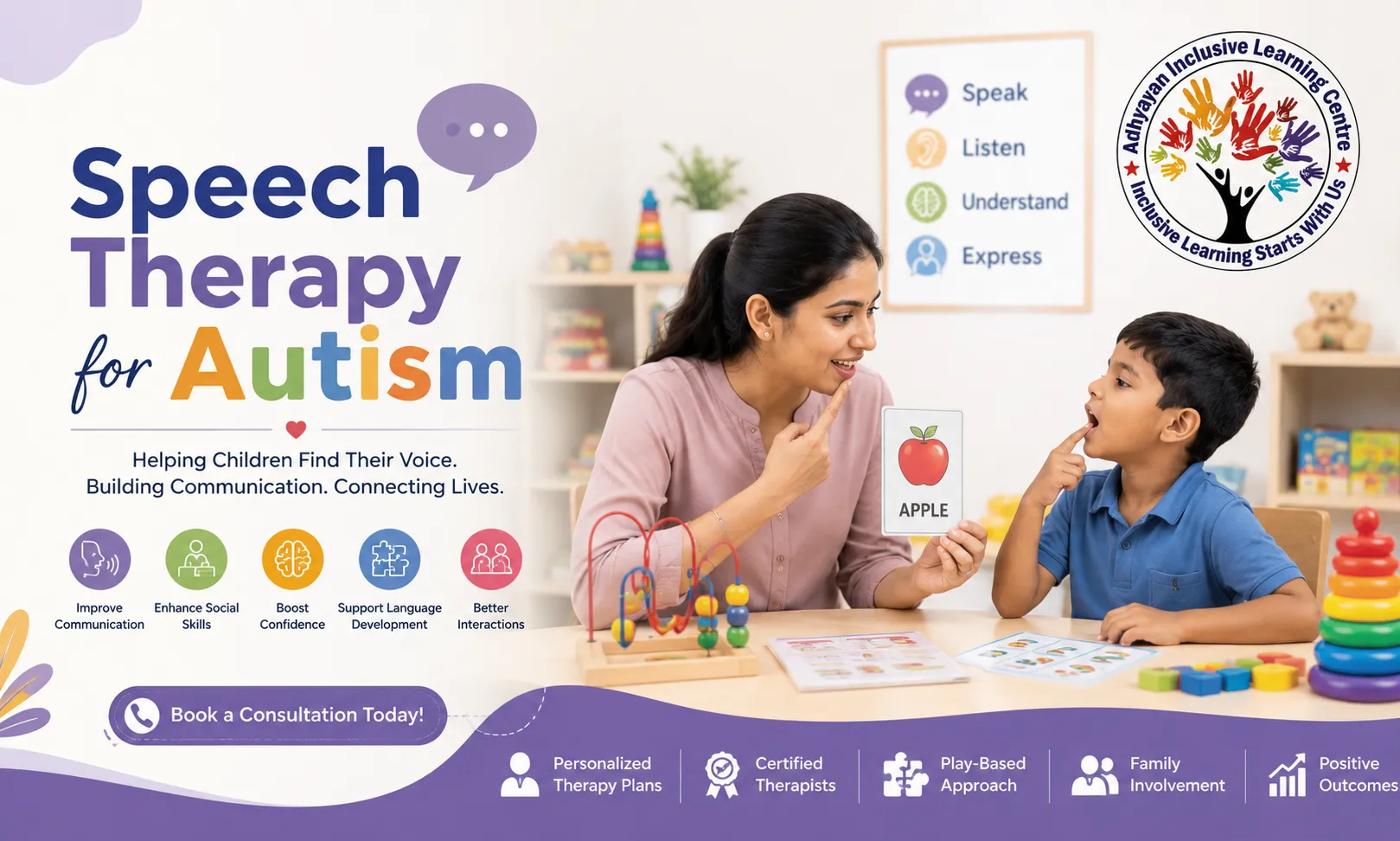
At Adhyayan Inclusive Learning Centre (AILC), speech and language therapy for autism is built around the individual child, not a fixed template. Our speech-language pathologists work alongside special educators, occupational therapists, and behavior therapists, so communication goals are supported across every part of a child's day — not just in a therapy room.
What we offer:
- Detailed speech and language assessment for children on the autism spectrum
- Individualized goal-setting based on the child's current communication level (verbal, non-verbal, or emerging)
- AAC-based support, including PECS and communication devices, for non-verbal and minimally verbal children
- Articulation and language development therapy for verbal children
- Social communication and conversation-building sessions, including small group work
- Ongoing parent coaching so progress carries over at home
- Multidisciplinary coordination with occupational therapy, ABA, and special education under one roof
With over 30 years of experience and thousands of children supported, our team understands that no two autistic children communicate the same way — and therapy shouldn't either.
Book a consultation to get a personalized speech therapy assessment for your child, at our centre in South Extension, South Delhi, serving families across Delhi NCR.
📞 +91 98100 52388 | +91 88609 00253