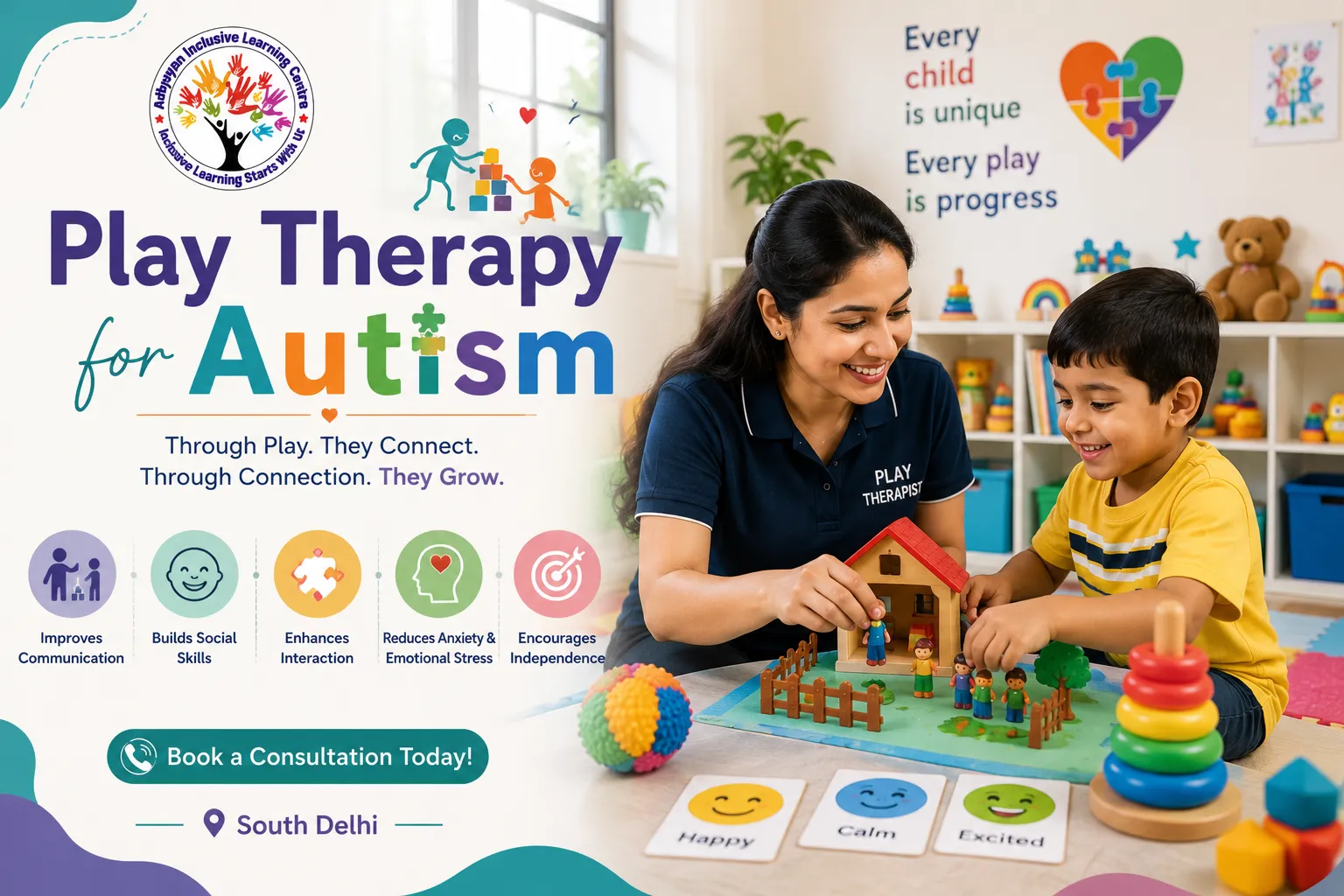
Play looks effortless from the outside. A child stacking blocks, pushing a toy car across the floor, or pretending to feed a stuffed animal seems like simple, ordinary fun. But for children on the autism spectrum, play often does not come naturally the way it does for other children, and that is exactly why play therapy has become such a valuable tool in autism intervention.
Having spent years observing therapy sessions and working alongside pediatric therapists, one pattern stands out clearly. Children on the spectrum are not incapable of play. They simply experience it differently, and often need a guide to help them discover how enjoyable, meaningful, and connecting play can actually be. Play therapy for autism is not about entertainment. It is a structured, purposeful clinical approach that uses play as the primary language through which a child learns to communicate, regulate emotions, and build social understanding.
What Is Play Therapy for Autism
Play therapy is a therapeutic approach where trained professionals use play based activities to help children develop skills they may not acquire naturally through typical development. For autistic children, this often means working on joint attention, imitation, turn taking, emotional regulation, and functional or imaginative play skills.
Unlike free, unstructured play, play therapy sessions are carefully designed around specific developmental goals. A therapist might use a simple game of rolling a ball back and forth to build turn taking and eye contact. Pretend play with dolls or action figures might be used to practice sequencing events or understanding emotions. Sensory bins filled with rice, sand, or water might help a child tolerate different textures while building fine motor coordination.
What makes play therapy so effective for autism specifically is that it meets the child where they are. Rather than forcing a child to sit at a table and follow verbal instructions, which can feel overwhelming and unnatural, play therapy allows learning to happen through an activity the child's brain is naturally wired to engage with. Play is, after all, how every child learns about the world, cause and effect, social rules, language, and emotional expression.
Why Play Does Not Come Naturally for Many Autistic Children
To understand why play therapy matters so much, it helps to understand why play can be genuinely difficult for a child on the spectrum. Many autistic children show a strong preference for repetitive actions over imaginative or flexible play. A child might line up cars repeatedly instead of using them for pretend scenarios like a race or a story. Others might struggle to understand the unspoken social rules of play, like taking turns, sharing attention, or responding to a peer's cues.
Sensory differences also play a huge role. A noisy playground, a crowded birthday party, or even the texture of certain toys can feel overwhelming rather than fun. Add to this the communication challenges many autistic children face, and it becomes clear why play, something so instinctive for most children, can feel confusing or even distressing for others.
This is where a skilled therapist becomes essential. They do not force typical play patterns onto a child. Instead, they observe what genuinely interests the child, whether that is spinning objects, sorting by color, or watching things fall, and use that interest as a doorway into building new skills gradually and respectfully.
Common Play Therapy Techniques for Autism
There is no single method that works for every child, which is why experienced therapists draw from a range of play therapy techniques for autism, adjusting based on the child's age, sensory profile, communication level, and interests.
Floortime therapy is one widely used approach, where the therapist or parent gets down on the child's level, quite literally on the floor, and follows the child's lead during play. Instead of directing the activity, the adult joins in, gently expanding on what the child is already doing to build communication and emotional connection.
Structured turn taking games like rolling a ball, stacking rings, or simple board games help build the foundational social skill of waiting and responding to another person's actions, something many autistic children need explicit practice with.
Pretend and imaginative play using dolls, action figures, or a play kitchen helps children practice sequencing, storytelling, and understanding emotions and perspectives beyond their own.
Sensory integrated play incorporates textures, movement, and different sensory materials into play sessions, helping children build tolerance for sensory input in a controlled, enjoyable way rather than an overwhelming one.
Social stories through play use simple narratives acted out with toys to help children understand social situations they might find confusing, like sharing, greeting a friend, or handling disappointment.
Simple Play Therapy Ideas for Autism That Parents Can Try at Home
While professional guidance is important, many play therapy ideas for autism can be adapted for home use, and this is often where the most meaningful progress happens, since children spend far more hours at home than in a clinic.
Bubble play is a wonderful low pressure activity. Blowing bubbles and encouraging a child to pop them, or asking them to say "more" or "pop" before blowing again, gently builds both language and joint attention.
A simple cause and effect toy, like a jack in the box or a toy with buttons that trigger sounds or lights, can help build anticipation and shared enjoyment between parent and child.
Building towers together and taking turns knocking them down introduces the concept of turn taking in a way that feels genuinely fun rather than instructional.
Using a mirror during play, making faces together and naming emotions like happy, surprised, or silly, can support emotional recognition in a playful, low stakes setting.
Even everyday routines like bath time or mealtime can become small play therapy moments, using songs, simple back and forth exchanges, or gentle sensory play with water or food textures.
The key with all of these ideas is following the child's interest first, rather than insisting on a specific "correct" way to play. Progress happens gradually, through repetition, patience, and genuine connection rather than pressure.
How Play Therapy Fits Into a Broader Autism Intervention Plan
Play therapy rarely works in isolation. Most experienced clinical teams integrate it alongside other therapies, since autism intervention tends to be most effective when it addresses multiple developmental areas together. For instance, many children benefit from combining play based sessions with Applied Behavior Analysis, which helps reinforce specific skills learned during play through consistent, structured practice across settings.
Similarly, Speech Therapy often works hand in hand with play, since play naturally creates opportunities for language use, whether that is requesting a toy, commenting on an action, or responding to a question during a game. Children who struggle with fine motor coordination or sensory regulation during play activities also often benefit from Occupational Therapy, which addresses the physical and sensory foundations that make play, and daily functioning in general, more comfortable and accessible.
For younger children, particularly those recently diagnosed or showing early signs of developmental delay, Early Intervention programs frequently use play as the primary teaching medium, since young children learn most naturally through play rather than direct instruction. Starting these combined therapies early tends to produce the strongest long term outcomes, as the brain's neuroplasticity in early childhood allows new skills to form more readily.
What Progress in Play Therapy Actually Looks Like
Parents sometimes expect dramatic, fast changes, and it is important to set realistic expectations here. Progress in play therapy is usually gradual and shows up in small, meaningful moments rather than overnight transformations.
A child might start by simply tolerating a new toy without distress. Over weeks, that same child might begin imitating a simple action with the toy. Eventually, that imitation might evolve into initiating play independently, then inviting a parent or sibling to join in. Each of these steps represents real developmental growth, even if it does not look dramatic from the outside.
Therapists typically track specific, measurable goals, like increased eye contact during play, longer periods of shared attention, or an expanding range of play themes beyond repetitive patterns. Regular reassessment ensures the therapy plan evolves as the child grows and develops new skills.
A Note for Parents Just Starting This Journey
If you are exploring play therapy for autism because you have noticed your child struggles with typical play, know that this is an incredibly common experience, and one that responds well to the right support. Play therapy is not about changing who your child is. It is about building a bridge into a world of connection, communication, and joy that might currently feel just out of reach for them.
With patience, consistency, and the right combination of therapies tailored to your child's individual needs, most children make genuine progress over time. Small moments of shared laughter over a rolling ball, a wave goodbye that becomes intentional, or a first pretend tea party, these are the milestones that matter most, and they are entirely achievable with the right guidance and a good deal of loving persistence.