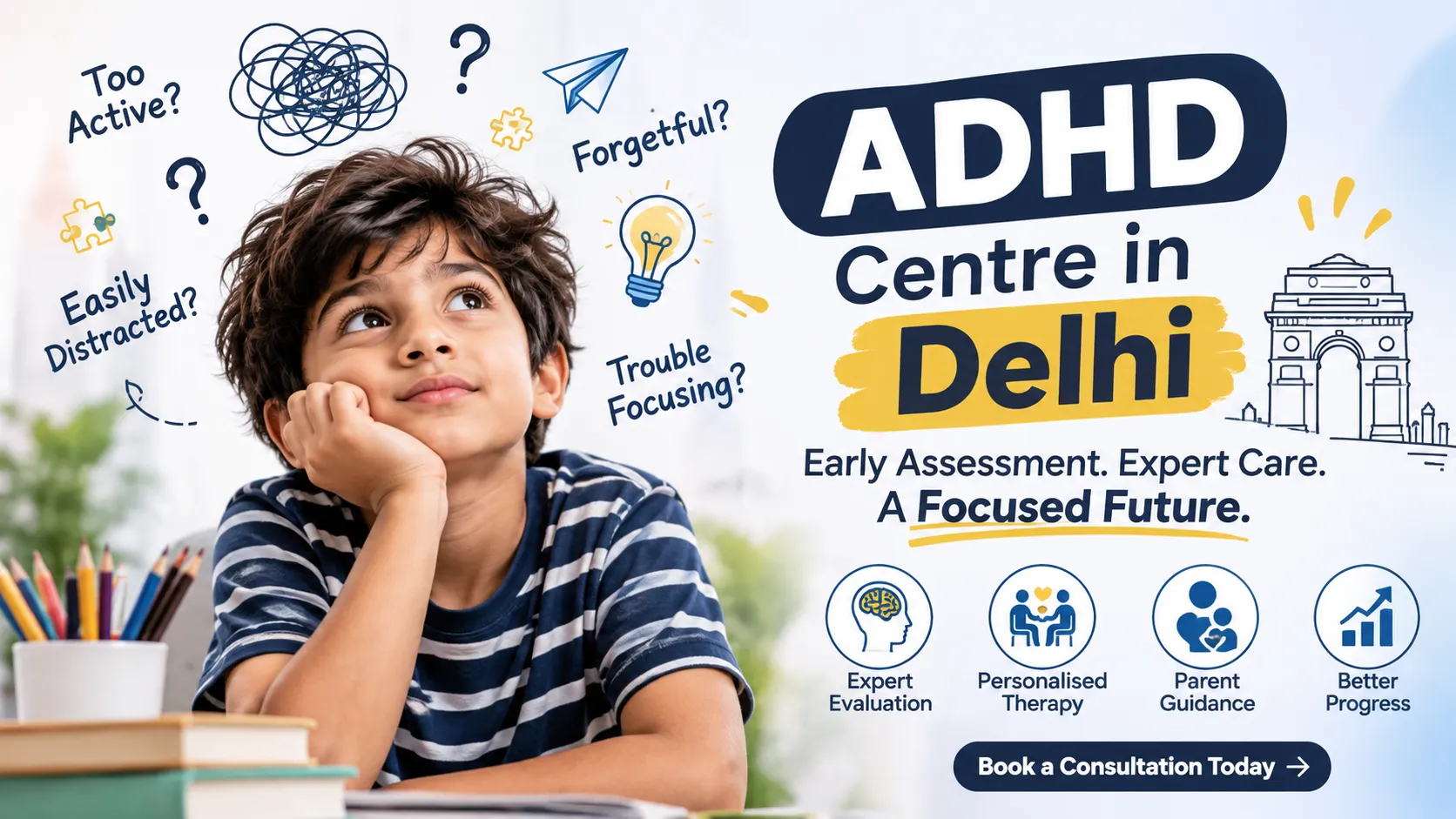
If your child cannot sit through homework, forgets instructions within minutes, blurts out answers or is described as "lazy" and "careless" in every school report, you may be looking for an ADHD centre in Delhi that understands children, not just a diagnosis. At Adhyayan Inclusive Learning Centre (AILC), we assess attention, behaviour and learning together, and then build a practical plan that works at home and in the classroom.
This page explains what ADHD is, how our assessment works, which therapies and supports we offer, what parents and teachers can expect and how to start.
What Is ADHD?
Attention-deficit/hyperactivity disorder (ADHD) is a neurodevelopmental condition that affects attention, activity levels and impulse control. Commonly cited estimates suggest that roughly 5 to 7 in every 100 children worldwide have ADHD, and it often continues into adolescence and adulthood.
ADHD is not caused by poor parenting, too much sugar or a lack of discipline. It reflects differences in how the brain manages attention and self-control. Children with ADHD often have real strengths such as energy, creativity and curiosity. The aim of support is to build skills and remove obstacles, not to suppress the child.
Signs of ADHD in Children
Inattention
- Makes careless mistakes or misses details in schoolwork
- Struggles to stay focused on tasks or play
- Seems not to listen when spoken to directly
- Loses books, pencils, tiffin boxes and other belongings
- Avoids tasks that need sustained effort, such as homework
- Is easily distracted and forgetful in daily routines
Hyperactivity and impulsivity
- Fidgets, taps or squirms when seated
- Leaves their seat in class or at the dining table
- Runs or climbs at inappropriate times
- Talks excessively and interrupts others
- Finds it hard to wait for a turn
- Acts without thinking about consequences
Under the commonly used diagnostic criteria, a child usually shows several of these signs for at least six months, with signs present before age 12 and in more than one setting, such as home and school. Many other conditions can look like ADHD, which is why careful assessment matters.
Why Assessment Matters
Attention difficulties can come from ADHD, but also from anxiety, learning disabilities, language delay, sensory processing differences, hearing or vision problems, poor sleep or stress. A child who cannot follow a lesson because the language is too fast for them is not the same as a child whose attention drifts. Treating the wrong cause wastes time and energy.
A good assessment looks at the whole child before reaching a conclusion. Read more in our guide to ADHD assessment in Delhi.
How Our ADHD Assessment Works
Step 1: Parent interview and history
We ask about pregnancy and birth, early development, sleep, health, school performance, family routines and what worries you most. Bring school reports, teacher notes and any earlier medical or psychological reports.
Step 2: Observation and rating scales
Our team observes your child during structured activities and play. Parents and teachers complete standardised questionnaires so that we see behaviour across settings.
Step 3: Psychological and learning assessment
Where needed, our psychologists assess thinking skills, attention, memory and academic skills to find strengths and gaps, including learning disabilities that often co-occur with ADHD. See our psychometric evaluation service for details.
Step 4: Feedback and written plan
We explain the findings in plain language and give a written report with recommendations for therapy, home strategies and school support. Where medical review is appropriate, we coordinate with your paediatrician or child psychiatrist, since medication decisions are made by doctors.
ADHD Therapy and Support at AILC
Behaviour support and parent training
Research consistently supports behavioural strategies and parent training as a core part of ADHD care. We teach parents to set clear routines, give effective instructions, use rewards and consequences consistently and reduce daily conflict. Our behaviour modification programme builds these skills step by step.
Occupational therapy
Many children with ADHD also have sensory, motor coordination or handwriting difficulties, and trouble with self-regulation. Our occupational therapy team works on movement breaks, body awareness, attention routines and daily living skills.
Special education and learning support
Children who have fallen behind need targeted help with reading, writing, maths and study skills. Our special education programmes use short tasks, visual cues and frequent feedback to keep children engaged.
Counselling
Children with ADHD often face low self-esteem, anxiety and conflict with peers. Our counselling service supports emotional wellbeing for children, teens and parents.
Speech and language therapy
Where language difficulties sit alongside attention difficulties, our speech and language therapists work on listening, understanding and expressing ideas.
To learn how these approaches fit together, read our guide to ADHD treatment in Delhi.
ADHD at Different Ages
Preschool years
Very young children are naturally active, so a diagnosis is rarely made early. Still, intense restlessness, very short attention, frequent injuries from impulsive climbing or strong difficulty with group routines deserve a closer look. Parent training is often the first and most effective step.
Primary school
This is when most families notice a problem, because the classroom demands sitting, listening and finishing work. Children may rush through tasks, lose belongings or struggle to keep friends.
Teenage years
Hyperactivity often fades into restlessness, while disorganisation, procrastination, missed deadlines and emotional ups and downs become the main concerns. Teens benefit from study skills coaching, planners, counselling and a say in their own plan.
Common Myths About ADHD
- "It is just bad behaviour." ADHD reflects differences in attention and self-control, not a character flaw
- "Children will grow out of it." Some improve, but many continue to need strategies into adulthood, and early support prevents years of struggle
- "Only boys have ADHD." Girls are often missed because they tend to be quietly inattentive instead of hyperactive
- "Intelligent children cannot have ADHD." ADHD occurs at every level of ability, and bright children may hide difficulties for longer
What We Do Not Do
We do not offer a "cure" or a quick fix, and we do not prescribe medication. We do not label children after one short meeting. We give honest, evidence-informed advice and will tell you if your child needs other services or a medical opinion.
How to Support a Child with ADHD at Home
- Keep routines predictable. Use visual schedules for mornings, homework and bedtime
- Give one instruction at a time and ask your child to repeat it back
- Break tasks into small steps, with short breaks between them
- Offer movement before sitting. A walk or short play before homework helps many children
- Notice effort, not only results, and praise specific actions straight away
- Protect sleep. Poor sleep makes attention and mood worse
- Limit screens before study time and bedtime
Supporting Your Child at School
We work with parents and, with your permission, share practical recommendations with teachers: seating near the teacher, short tasks with checkpoints, extra time for tests, written as well as spoken instructions, movement breaks and positive feedback. A written report from our team can also support requests for classroom accommodations.
Why Families Choose AILC
- One team under one roof: psychologists, special educators, occupational therapists, speech therapists and behaviour specialists
- 30+ years of experience with children with ADHD, autism, learning disabilities and developmental delay
- Personalised plans with clear goals and regular reviews
- Parent partnership: training, written home programmes and honest updates
- Convenient location at South Extension, easy to reach from South Delhi and Delhi NCR
Book an ADHD Consultation at AILC
Our centre is at E-17, 2nd Floor, South Extension Part 1, New Delhi 110049. Most sessions take place in the centre, with selected online consultations for follow-ups. To discuss your child's attention, behaviour or learning, book a consultation or call +91 98100 52388.