ADHD Assessment in Delhi: Process, Cost and What to Expect
Maybe it started with a note from school about your child not sitting still, or constantly losing track of instructions. Maybe you have noticed it yourself: the impulsiveness, the trouble finishing tasks, the restlessness that feels like more than just "a lot of energy." At some point, the word ADHD comes up, and the next question almost every parent asks is the same: what does an assessment actually involve, and what will it cost.
We have worked with families across Delhi and NCR for over three decades at Adhyayan Inclusive Learning Centre, and ADHD assessments are among the most common evaluations parents ask us about, often after months of wondering whether what they are seeing is typical childhood behaviour or something that needs professional support. This guide walks you through the full process, what drives the cost, and what to expect at each stage.
If you would rather skip the research and talk to someone directly, get in touch with our team and we will explain what an assessment for your child would specifically involve.
What Is an ADHD Assessment, Exactly?
An ADHD assessment is a structured evaluation designed to understand a child's attention, impulse control, and activity levels across different settings, not just a single behaviour observed at home or school. Since almost every child is inattentive or impulsive at some point, the assessment exists to distinguish typical childhood behaviour from a pattern that is significant enough, and consistent enough across settings, to be considered ADHD.
This is also why an ADHD assessment is never based on a single conversation or a short classroom observation. It combines structured questionnaires, direct observation, developmental history, and often input from more than one adult in the child's life, such as a parent and a teacher.
ADHD Assessment vs Autism Assessment: A Quick Clarification
Parents searching for an ADHD psychiatrist near me often end up comparing this with an autism assessment, since some early signs, like difficulty with attention or social situations, can look similar on the surface. The two evaluations look at different things: ADHD assessments focus on attention regulation, impulsivity, and hyperactivity, while autism assessments focus on social communication and repetitive behaviours. Some children are referred for both if there is overlap, which is why a good clinician always starts with a broad developmental history rather than assuming which evaluation is needed from the first phone call. If you want a closer look at how an autism-specific evaluation works, our guide on autism assessment in Delhi covers that process in detail.
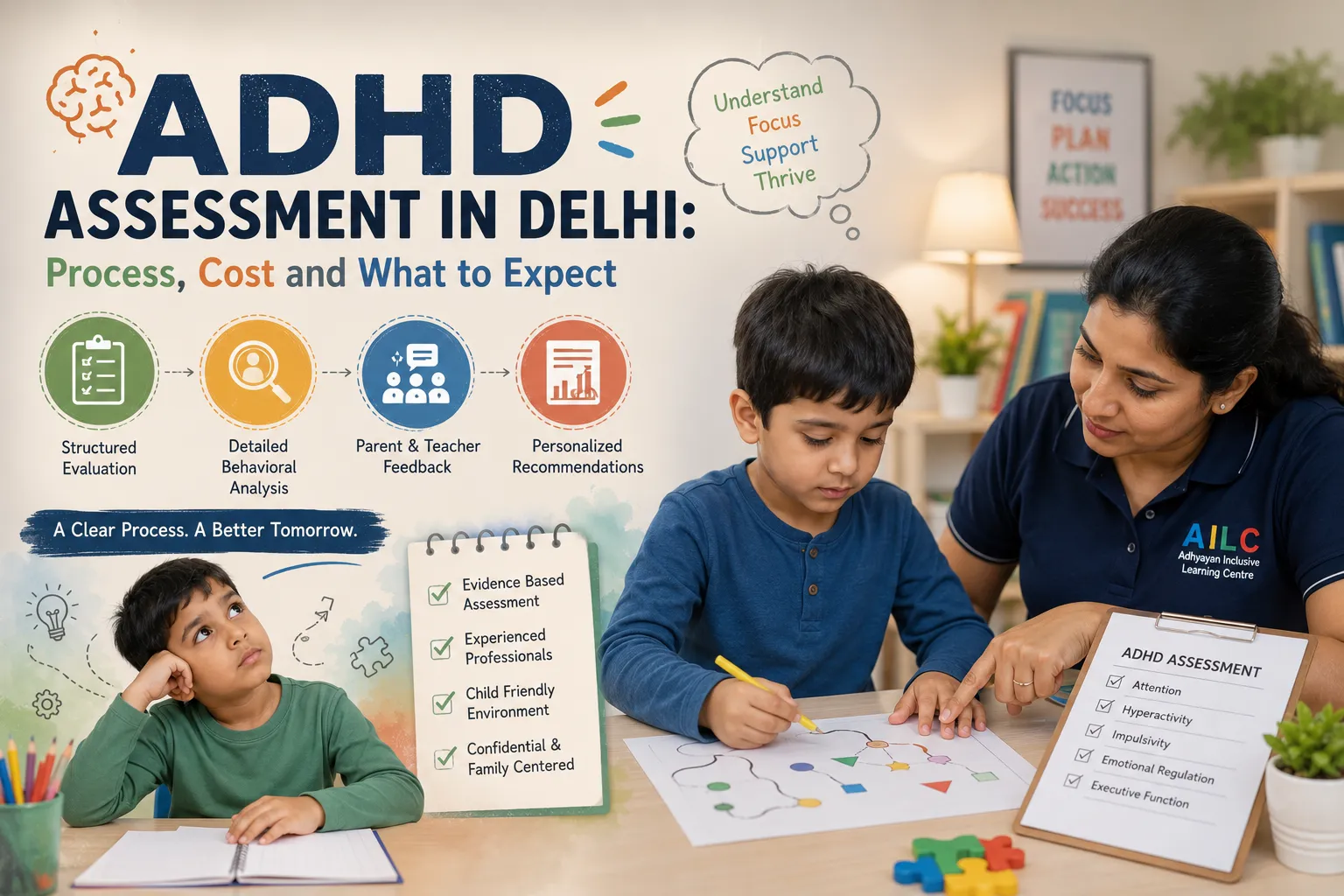
The ADHD Assessment Process: Step by Step
Initial intake and history. The process usually begins with a detailed conversation about your child's developmental history, behaviour at home, academic performance, and any concerns raised by school. This is also where a clinician asks about family history, since ADHD often has a genetic component worth noting.
Standardised rating scales. Parents and teachers are typically asked to fill out structured questionnaires, such as the Vanderbilt or Conners rating scales, which score specific behaviours related to attention, hyperactivity, and impulsivity. Having input from more than one setting, home and school, matters here, since ADHD symptoms need to be present across environments, not just in one.
Direct observation and clinical interview. A child psychiatrist, clinical psychologist, or developmental paediatrician typically spends time directly with the child, observing attention span, activity levels, and behaviour during structured tasks. This is combined with a clinical interview to understand the child's own perspective, where age-appropriate.
Cognitive and academic screening, where relevant. Since attention difficulties can sometimes overlap with learning difficulties, some evaluations include a brief cognitive or academic screening to rule out or identify co-occurring concerns, such as a specific learning disability.
Ruling out other explanations. Part of a thorough evaluation involves ruling out other reasons for the behaviour, such as anxiety, sleep difficulties, or a recent disruption at home or school, since these can sometimes present in ways that look similar to ADHD on the surface.
Feedback and report. At the end of the process, you receive a written report summarising the findings, along with a clear recommendation, whether that is behaviour modification, counselling, classroom accommodations, or a referral for medical management alongside therapy.
How Long Does the Process Take?
An ADHD assessment is rarely completed in a single sitting. Most evaluations in Delhi take place across two to three sessions: an initial intake, direct assessment with the child, and a feedback session once rating scales from home and school have been reviewed. From the first appointment to the final report, this usually takes anywhere from one to a few weeks, partly because teacher-completed questionnaires can take time to come back.
What Does an ADHD Assessment Cost in Delhi?
Costs vary depending on the centre, the qualifications of the professional involved, and how many components the assessment includes. As a general guide, a single consultation with a child psychiatrist or clinical psychologist typically falls in the range of a few hundred to a couple of thousand rupees, while a full structured assessment, including rating scales, observation, and a written report, is usually priced as a package rather than a single session fee, since it involves more than one appointment and professional's time.
A few things that typically affect the price:
- Whether the evaluation includes only a clinical interview, or a full battery with standardised rating scales and cognitive screening
- Whether a single professional is involved, or a multidisciplinary team including a psychiatrist and psychologist
- Whether teacher input and school-based observation are part of the process
- Whether a written report with detailed recommendations is included, or only a verbal opinion
As with most assessments, it is worth asking exactly what is included in a quoted price before booking, since a lower upfront fee sometimes means a narrower evaluation that may need to be supplemented later.
Signs That Usually Lead Parents to Seek an ADHD Assessment
This is not a checklist for self-diagnosis, but these are among the most common reasons parents pursue an evaluation:
- Difficulty sustaining attention on tasks or play, even ones the child enjoys
- Frequently losing things needed for tasks, like school supplies or homework
- Acting without thinking through consequences, or interrupting frequently
- Difficulty sitting still, especially in structured settings like a classroom
- Consistent feedback from school about attention or behaviour, alongside similar concerns at home
If several of these are showing up consistently across settings, and not just occasionally, an assessment is usually the most useful next step.
Conclusion
An ADHD assessment can feel like a big step, mostly because the process and cost are rarely explained clearly upfront. In reality, it is a structured, multi-step process designed to give you a clear, honest picture of your child, not just a label. At AILC, our team walks families through every stage, from the first conversation to the final report, so you know exactly what to expect and what it will involve before you begin.