Autism Assessment in Delhi: What Happens During the Evaluation
If your paediatrician has mentioned the word "assessment," or you have started noticing signs yourself, that first step can feel like the biggest one. Most parents come to this stage already carrying weeks or months of quiet worry, whether that is a child who is not responding to their name, a toddler who is not babbling yet, or a teacher who gently flagged something at school. What often makes it harder is not knowing what the assessment itself actually involves. Will it be one long appointment? Will my child be judged in a single sitting? What happens after?
We have worked with families across Delhi and NCR for over three decades at Adhyayan Inclusive Learning Centre, and one thing we tell every parent at the first phone call is this: an autism assessment is not a single test with a pass or fail. It is a structured process, usually spread across more than one session, designed to understand your child rather than label them quickly. This guide walks you through what actually happens at each stage, so you know what to expect before you walk in.
If you would rather talk this through with someone directly, get in touch with our team and we will explain what an assessment for your child would specifically involve.
Autism Assessment vs ADHD Assessment: Are They the Same Thing?
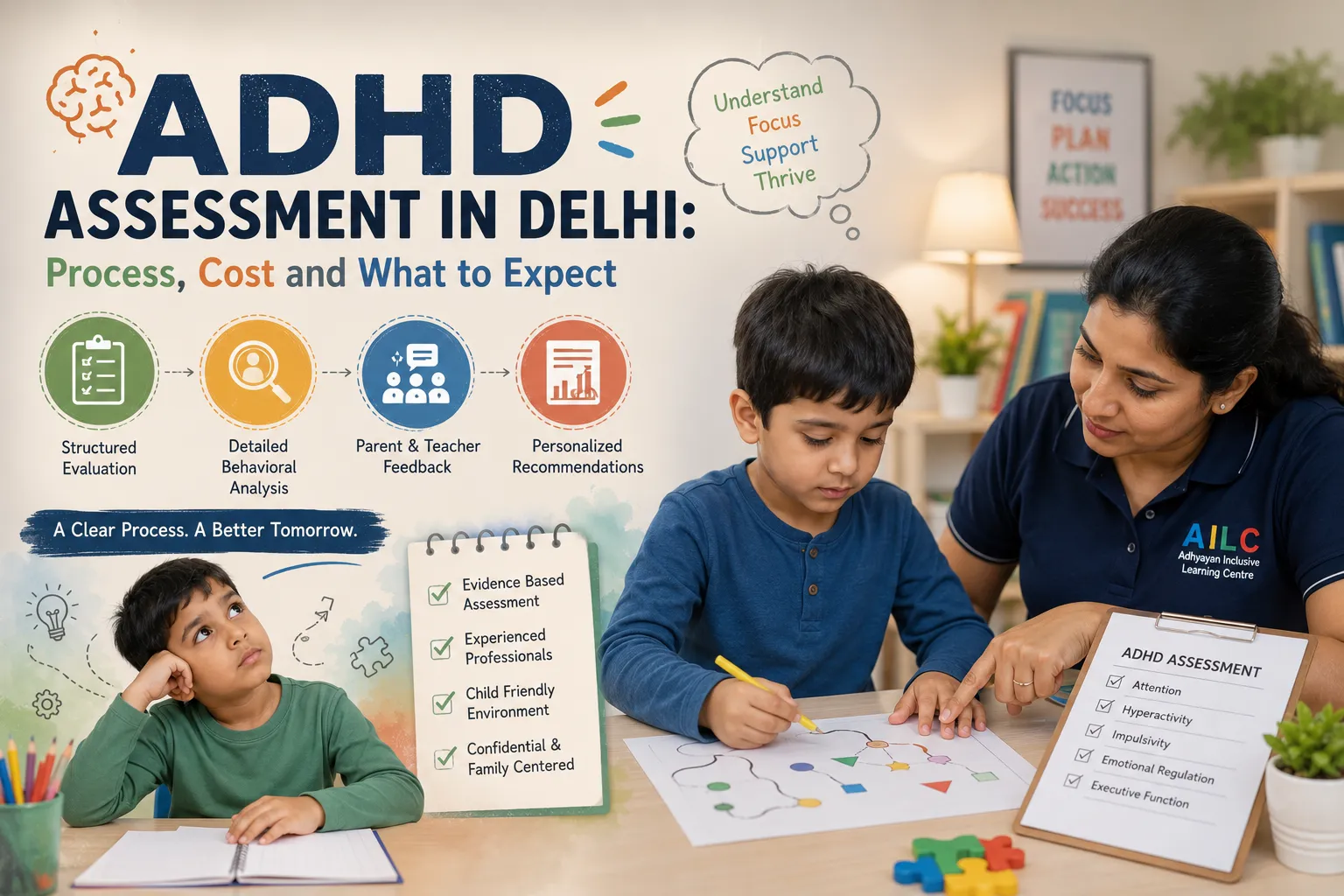
Parents often use "autism assessment" and "adhd assessment in Delhi" almost interchangeably, especially early on, because the initial concerns can look similar: a child who seems inattentive, easily overwhelmed, or behind on social milestones. In practice, these are different evaluations that look at different things.
An autism assessment focuses on social communication, restricted or repetitive behaviours, sensory responses, and how a child relates to the world around them. An ADHD assessment focuses more on attention regulation, impulsivity, and activity levels. The tools, questionnaires, and observation methods used in each differ, though some children are referred for both if there is overlap in symptoms. This is also why a good evaluation always starts with a detailed conversation about what you have actually observed, rather than jumping straight into one specific test.
What Happens Before the Evaluation Even Starts
Most centres, including ours, begin with an intake conversation rather than an appointment slot. This is where a clinician asks about your child's early development: when they sat up, walked, said their first words, how they play, how they respond to their name, and whether anyone else, like a school or paediatrician, has raised concerns. This step matters because autism presents very differently across children, and this history shapes which specific tools the evaluating team will use later.
If you have any old paediatrician notes, school observations, or a video of behaviours you are concerned about, most therapists will ask you to bring these along, since a five-minute description over the phone rarely captures what a short video clip can show clearly.
The Evaluation Itself: What Actually Happens in the Room
Parent and caregiver interview. A detailed conversation, usually 45 minutes to an hour, covering developmental history, current behaviours, sensory sensitivities, communication patterns, and daily routines. Parents are the single most important source of information here, since clinicians are seeing a snapshot while you see the full pattern.
Direct observation of the child. This is usually done through structured play or semi-structured activities designed to gently draw out how a child communicates, initiates interaction, responds to their name, uses eye contact, and engages with toys or people. Standardised tools such as ADOS-2 (Autism Diagnostic Observation Schedule) or CARS-2 (Childhood Autism Rating Scale) are commonly used across Delhi centres for this part, since they give a consistent, comparable way of scoring behaviours rather than relying on impression alone.
Cognitive and developmental screening. Many evaluations also include a brief assessment of the child's cognitive level, language ability, and adaptive skills, since autism can present alongside a range of developmental profiles, and understanding where a child sits helps shape the therapy plan that follows.
Sensory and behavioural observation. Clinicians also note how a child responds to sound, touch, movement, and changes in routine, since sensory processing differences are common alongside autism and directly affect how a therapy programme should be structured.
Multidisciplinary input, where needed. For a child with a more complex profile, an evaluation may involve more than one professional: a developmental paediatrician or child psychiatrist for a medical perspective, alongside a psychologist or special educator for the behavioural and developmental picture. Our own psychometric evaluation process is built around this same principle, since a single-professional opinion rarely captures the complete picture for a child with overlapping needs.
How Long Does the Whole Process Take?
A full autism evaluation is rarely completed in a single visit. Most centres in Delhi spread this across two to four sessions: an initial intake, one or more observation sessions with the child, and a feedback session where the findings are explained to parents. Depending on the centre and the complexity of the child's profile, this can take anywhere from a few days to a few weeks from the first call to the final report.
This is worth knowing upfront, mainly because some parents expect a same-day diagnosis and feel unsettled when it does not happen immediately. A slower, more thorough process is usually a sign of a careful evaluation, not a delay.
What You Receive at the End
A proper evaluation should end with a written report, not just a verbal opinion. This typically includes the clinical observations, standardised test scores where applicable, a developmental summary, and specific recommendations for next steps, whether that is speech therapy for autism, occupational therapy for autism, ABA therapy for autism, or a combination based on your child's specific needs.
This report also becomes useful later, whether for school accommodations, other specialists, or simply so you are not repeating the same history at every new appointment.
Signs That Usually Lead Parents to Seek an Assessment
Every child is different, and this is not a checklist for self-diagnosis, but these are among the most common reasons parents reach out for an evaluation:
- Limited or inconsistent response to their name being called
- Delayed babbling, first words, or overall speech development
- Limited eye contact or reduced interest in shared attention, such as pointing to show something
- Repetitive movements or intense focus on specific objects or routines
- Difficulty adjusting to changes in routine or environment
- Limited interest in interacting with other children
If several of these sound familiar, an assessment is usually the most useful next step, rather than waiting to see if things change on their own.
Conclusion
An autism assessment can feel intimidating mainly because it is unfamiliar, not because it is complicated once you know what to expect. At AILC, our team walks families through every stage of this process, from the first conversation to the final report, so that you are never left guessing what comes next. If you are noticing signs in your child and are unsure where to start, we are happy to talk you through what an assessment would look like for your specific situation.