Child Development Centre in Delhi: What Parents Should Look For
A parent usually starts looking for a child development centre in Delhi after a small worry has grown: a toddler who is not talking much, a four-year-old who cannot sit for a short activity, or a school report that mentions attention and handwriting. The right centre does more than name a problem. It looks at the whole child and builds a plan that parents, teachers and therapists can follow together.
This guide explains what a child development centre does, which milestones and red flags matter at each age, what a good developmental assessment includes, and how to compare centres so that you can act early and with confidence.
What Is a Child Development Centre?
A child development centre assesses and supports children across the main areas of growth: communication, movement, thinking and learning, play and social interaction, behaviour and daily living skills. Unlike a clinic that offers one service, a good centre brings several specialists together so that one child's needs are not handled in separate silos.
The team usually includes speech and language therapists, occupational therapists, special educators, behaviour therapists and counselling psychologists. Paediatricians, neurologists and developmental paediatricians are often involved from the medical side, and a centre should work with them rather than replace them. At Adhyayan Inclusive Learning Centre (AILC), therapy, special education and behaviour support run under one roof, which makes it easier to share notes and agree on priorities.
Developmental Milestones: What Is Expected and When
Milestones are skills most children show by a given age. In 2022 the US Centers for Disease Control and Prevention, together with the American Academy of Pediatrics, revised its milestone checklists so that each item is one that at least 75 percent of children have reached by that age, and added checklists at 15 and 30 months. The change was made partly because "wait and see" advice had delayed support for some children.
The ranges below are general guides. They are not a diagnosis, and children vary, so use them to decide when to ask a professional, not to label your child.
- By 12 months: responds to their name, babbles, uses gestures such as waving or pointing, tries to copy sounds and may say a first word such as "mama".
- By 18 months: says several words, follows simple directions with gestures, points to show things and walks independently.
- By 24 months: uses two-word phrases such as "more milk", follows simple directions without gestures, and is understood by familiar people at least half the time.
- By 3 years: speaks in short sentences, plays alongside other children, climbs and runs, and begins to use pretend play.
- By 4 to 5 years: tells a simple story, takes turns, draws recognisable shapes, hops, and is mostly understood by people outside the family.
Red Flags That Should Not Wait
Seek an assessment promptly if you notice any of the following:
- Loss of skills the child once had, such as words, eye contact or play
- No babbling or gestures by 12 months, or no words by 16 to 18 months
- No response to name or to sounds, which also calls for a hearing check
- No two-word phrases by about 24 months
- Not sitting, standing or walking at expected ages
- Very limited eye contact, little shared interest or unusual repetitive movements
- Extreme difficulty with feeding, sleep or change that affects the whole family
Our guides to toddler speech delay signs and wait and watch versus assessment explain how to decide when a slower start is worth checking.
Common Developmental Concerns a Centre Supports
Speech and language delay
Some children understand well but speak little, others struggle to understand instructions, and many have both difficulties. A speech and language therapist can tell which pattern your child has and plan therapy accordingly. Our article on language development therapy in Delhi explains the difference in detail.
Global developmental delay
When a young child is behind in two or more areas, such as motor, language and thinking, specialists may use the term global developmental delay. Our guide to global developmental delay in children covers causes, assessment and therapy.
Autism and social communication differences
Limited eye contact, few gestures, difficulty with play and strong sensory reactions can point to autism. A formal evaluation by a qualified team is needed. See what the process involves in autism assessment in Delhi.
Attention, behaviour and learning difficulties
Frequent meltdowns, high restlessness, trouble finishing tasks or struggles with reading, writing and number work may reflect ADHD, a learning disability or an unmet sensory or language need. A developmental assessment separates these so that support targets the real cause.
What Happens During a Developmental Assessment
Parent interview and history
The team asks about pregnancy, birth, early milestones, health, hearing, vision, sleep, feeding, play, school and family routines. Bring medical reports, school notes and short videos of the behaviour you are worried about, since a child may behave differently in an unfamiliar room.
Observation and standardised tools
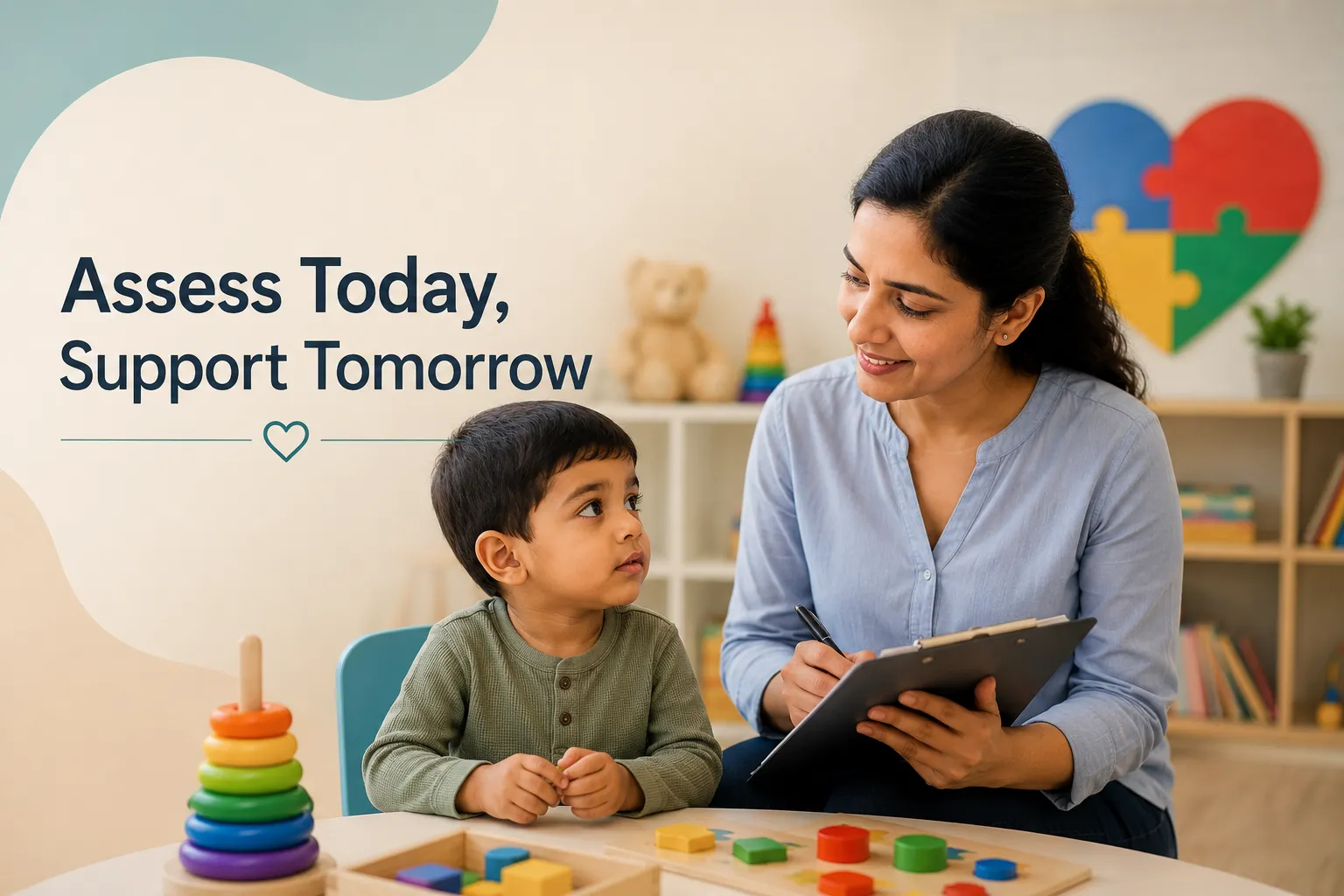
Specialists observe how your child plays, communicates, moves and follows instructions. Standardised tools chosen for age and concern may be used for language, motor skills, development or learning. Screening tools are not diagnoses, and a good team explains which results are screening and which are diagnostic.
Findings and a written plan
You should leave with a plain-language explanation of strengths, areas of need, the therapies recommended, how often sessions should happen and the goals for the next three to six months. A centre that cannot explain its plan simply should be questioned.
Services a Good Child Development Centre Should Offer
- Developmental assessment with a clear written summary for parents
- Early intervention programmes for young children, based on play and routines
- Speech and language therapy for speech, language and social communication
- Occupational therapy for sensory, fine motor and self-care skills
- Special education for learning difficulties and school readiness
- Behaviour support and parent guidance for routines, tantrums and transitions
- Psychological assessment and counselling where needed
Not every child needs every service. The strength of a centre lies in recommending the right mix and changing it as the child grows.
How to Choose the Best Child Development Centre in Delhi
Use these questions when you visit or call. They apply to any centre, including ours.
- Who will assess my child, and what are their qualifications and experience with my child's age group?
- How do the speech, occupational and special education teams share information?
- Will I receive written goals and progress reviews every few months?
- How will parents be trained to continue support at home?
- Can the centre coordinate with my child's school and doctor?
- Is the environment calm, safe and suited to my child's age and sensory needs?
- Is the centre honest about what therapy can and cannot achieve?
Be wary of any centre that promises a cure, offers the same programme to every child or discourages you from seeing a doctor.
Why Starting Early Matters
The brain is especially adaptable in the first years of life, and many skills build on earlier ones. A child who begins to communicate with gestures and words often has fewer behaviour difficulties, since frustration falls. Early support also gives parents practical tools during the years that matter most. Starting early does not mean a child will be labelled for life. It means getting information and support while it is easiest to use.
Child Development Support at AILC, South Extension
AILC has supported children with autism, ADHD, dyslexia, learning disabilities and developmental delays for more than 30 years. Our multidisciplinary team works from E-17, 2nd Floor, South Extension Part 1, New Delhi, and families come to us from across South Delhi and Delhi NCR. Most therapy takes place at the centre, with selected online consultations for added convenience.
If you would like clarity on your child's development, book a consultation or call +91 98100 52388.