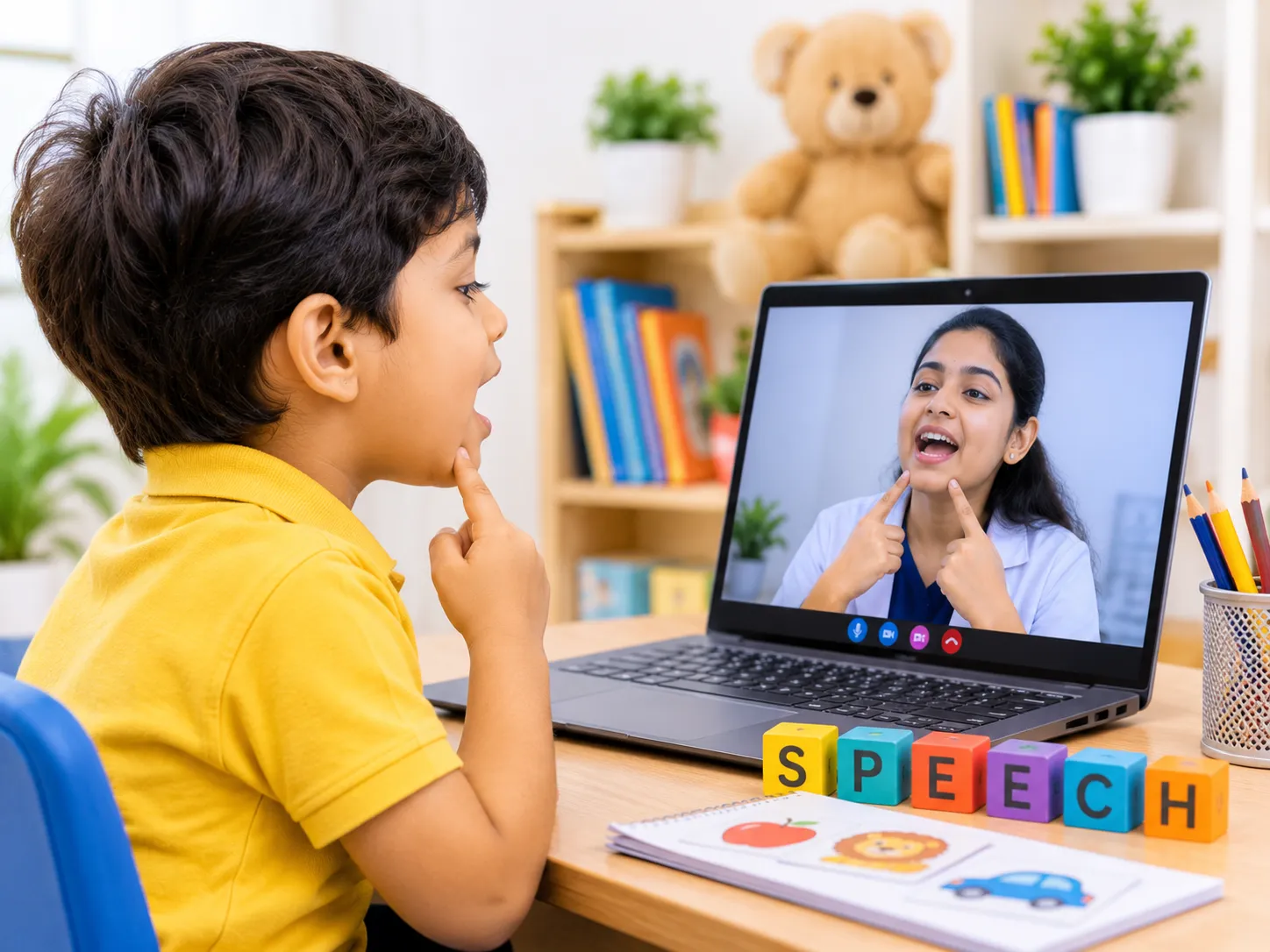
Many parents search for online speech therapy after a long commute, a waiting list or a busy school week makes regular clinic visits hard. The practical question is simple: can a child really learn to speak, understand and communicate better through a screen? For many children the answer is yes, as long as the child, the home set-up and the therapist are a good match.
This guide explains how online speech therapy for children in India works, who it suits, who needs in-person sessions, what research says, what you need at home and how to choose a qualified therapist.
What Is Online Speech Therapy?
Online speech therapy, also called teletherapy or telepractice, is speech and language therapy delivered over a video call. The child and a parent join from home, and a licensed speech and language therapist guides activities using the screen, shared digital materials and simple objects from around the house.
The goals are the same as in clinic therapy: clearer speech sounds, better understanding of language, more words and sentences, smoother fluency, and stronger social communication. What changes is the delivery. Parents sit beside the child and become active partners, which many families find to be the biggest benefit.
Does Online Speech Therapy Work?
Professional bodies such as the American Speech-Language-Hearing Association recognise telepractice as an appropriate way to deliver speech and language services, provided the therapist uses sound clinical judgement. Studies comparing teletherapy with in-person therapy for speech sounds and language have generally found similar outcomes for many children, particularly when parents take part. Evidence is less settled for very young children, children with severe attention difficulties and children who need physical, hands-on support.
In practice, success depends less on the screen and more on four things: a clear assessment, goals that fit the child, a parent who practises between sessions, and a therapist who adapts activities to a screen-based format.
Which Children Benefit Most from Online Sessions?
- Children with articulation difficulties, such as difficulty with "r", "s" or "sh" sounds, because the therapist can model sounds and watch the mouth clearly on camera
- Children with mild to moderate language delay, who respond well to play, stories and parent coaching
- Children who stutter, where strategies can be practised in the comfort of home
- School-age children who can sit for 25 to 40 minutes and enjoy games and screen activities
- Families who live far from a centre, travel often or live outside Delhi NCR
- Parents who want to learn the techniques and use them in daily routines
When In-Person Therapy Is the Better Choice
Online sessions are not right for every child. In-person therapy is usually better when:
- The child is under about two and a half years old and cannot attend to a screen yet
- There are feeding, swallowing or oral motor needs that require hands-on work. See our page on oral motor therapy
- The child has autism with significant sensory, attention or behaviour needs and finds it hard to engage with a screen
- The child needs a combined plan with occupational therapy or special education
- The home is noisy or there is no adult available to sit with the child
Many families choose a mix: an in-person assessment and regular sessions at the centre, with occasional online follow-ups for review, home programme updates or missed weeks.
What Happens in an Online Speech Therapy Session?
Before the first session
The therapist collects history by form or call: birth and medical history, hearing, milestones, languages spoken at home and what worries you most. You may be asked to share a short video of your child playing or talking. An initial assessment may include a parent interview, play observation and informal tasks. For children who need formal testing, an in-person visit is often advised.
During a session
A typical session lasts 30 to 45 minutes. It might include a warm-up song or greeting, a main activity such as a story, picture game or building task, repeated practice of target sounds or words, and a short parent coaching segment. The therapist may share the screen to show pictures, use a digital whiteboard or send a worksheet.
After the session
You receive a short summary and a few home activities, such as reading a picture book with specific question prompts or practising five target words in daily routines. Progress is reviewed every few weeks, and goals are updated.
What You Need at Home
- A laptop, tablet or large phone on a stable stand, with a camera that shows your child's face and hands
- A steady internet connection and headphones if your home is noisy
- A quiet corner, free from television and siblings, with a table and a chair at the right height
- A few simple items: favourite toys, picture books, paper and crayons, and snacks for breaks
- An adult who can sit with your child, follow the therapist's cues and repeat activities later in the day
Tips to Get the Most from Online Therapy
- Keep sessions at the same time each day so that the child expects them
- Take a short break for water and movement before the session starts
- Follow the therapist's lead during the call. Joining in often helps the child to join in
- Write down questions and share video clips of your child's speech at home
- Practise for 5 to 10 minutes a day instead of a long weekly session. Short and frequent practice works better
- Stay patient. Progress comes in small steps
How to Choose a Qualified Online Speech Therapist in India
- Check registration. In India, speech and language pathologists and audiologists are registered with the Rehabilitation Council of India (RCI). Ask for the registration number and qualifications
- Ask about experience with your child's age group and concern
- Look for a clear plan: assessment, written goals, session length and review dates
- Confirm parent coaching is included, since that is where much of the progress is made
- Understand the fees and cancellation policy in advance. Our guide to therapy costs in Delhi explains what affects pricing
- Avoid promises of a cure or a fixed number of days
Our parents' checklist for choosing speech therapy in Delhi works equally well for online providers.
If you may later want in-person sessions, it helps to know what the nearest centre looks like. For AILC in South Extension, parent reviews and directions are on Google Maps.
When to Start: Signs Your Child Needs Speech Therapy
Do not wait if you notice any of these signs. Early help is easier than late help, and an assessment does not commit you to therapy.
- No babbling or gestures by 12 months, or no words by 16 to 18 months
- No two-word phrases by about 24 months
- Speech that family members cannot understand after age three
- Difficulty following simple instructions
- Stuttering that lasts more than a few months or worries your child
- Loss of words or social skills that were present before
Read more in our guides to toddler speech delay signs and late talker versus speech delay.
Speech Therapy at AILC, South Extension
Adhyayan Inclusive Learning Centre offers speech therapy for kids at our centre at E-17, 2nd Floor, South Extension Part 1, New Delhi, along with selected online consultations for families who cannot attend every week. Our team has worked with children with speech and language delay, autism, ADHD and learning difficulties for more than 30 years. A short consultation helps us tell you whether online sessions, in-centre therapy or a mix will suit your child best.
To discuss your child's needs, book a consultation or call +91 98100 52388.